Getting Started
Wild Fermentation vs. Using a Starter Culture
Should you rely on wild microbes or add a starter culture? Learn the real difference, when each method makes sense, and how to keep both safe.
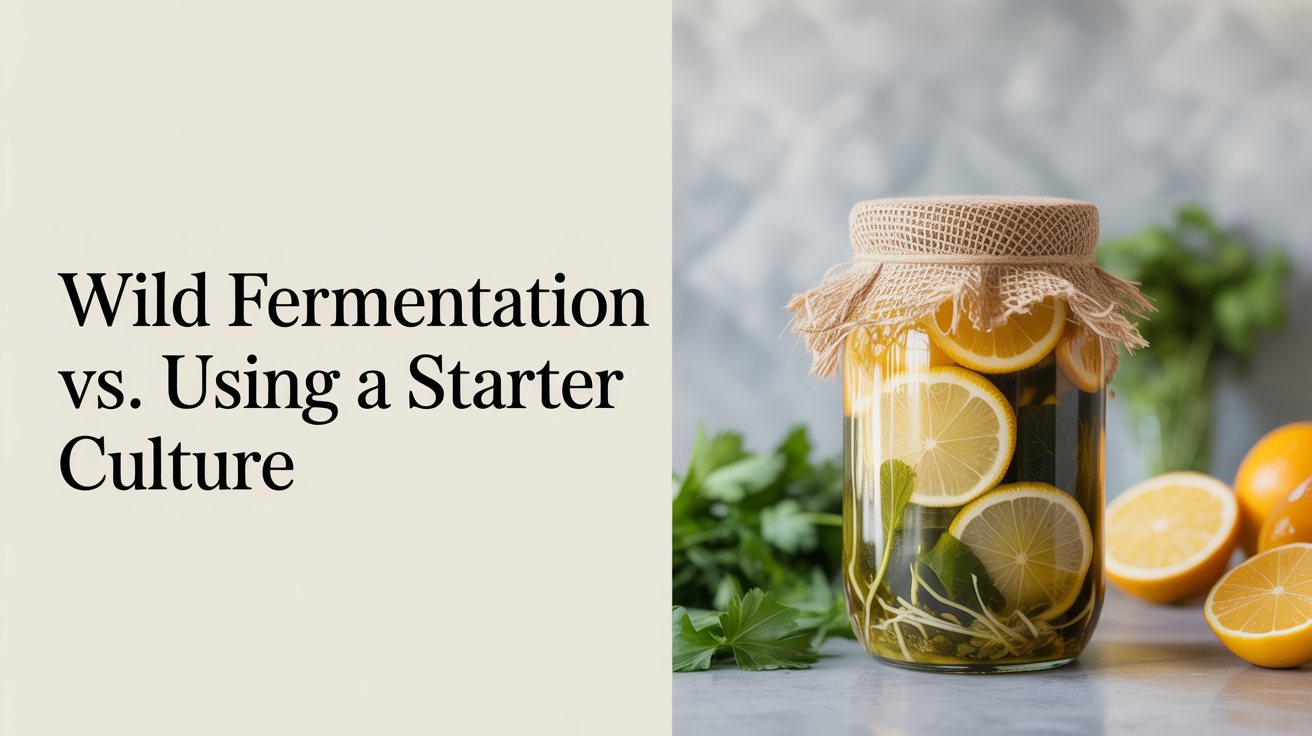
When you make your first batch of sauerkraut or lacto-pickles, you do not add anything except salt and vegetables. The bacteria already living on the cabbage leaf do all the work. That is wild fermentation. When you make yogurt, you stir in a spoonful of last week's yogurt to get things going quickly. That is a starter culture. Both methods produce real, living fermented foods, but they work through different mechanisms, suit different projects, and carry different levels of predictability.
Understanding which approach fits which job helps you set expectations, troubleshoot problems, and keep things safe. If you are just getting started, how to start fermenting at home: a complete beginner's guide covers the broader picture before you dive into the details below.
What Is Wild Fermentation?
Wild fermentation relies entirely on the microorganisms already present on your ingredients, in the air, and on your equipment. You are not adding a culture on purpose. Instead, you create conditions that favor the microbes you want and suppress the ones you do not.
For vegetable ferments, that means salt. When you massage 2% salt by weight into shredded cabbage, you draw out liquid and create a brine that is inhospitable to most harmful bacteria but comfortable for Lactobacillus species. Those lactic acid bacteria are naturally present on cabbage leaves, and they begin eating the sugars in the vegetable juice. As they produce lactic acid, the brine becomes more acidic, and that rising acidity keeps the environment safe and discourages spoilage organisms further.
The key numbers for common wild vegetable ferments:
| Project | Salt by weight | Temperature | Typical time |
|---|---|---|---|
| Sauerkraut | 2 to 2.5% | 65 to 75°F / 18 to 24°C | 1 to 4 weeks |
| Lacto pickles | 2 to 3% brine | 65 to 75°F / 18 to 24°C | 3 to 7 days |
| Kimchi | 2 to 3% | 65 to 75°F / 18 to 24°C | 1 to 4 weeks |
At 2%, your cabbage has enough salt to favor Lactobacillus without becoming unpleasantly salty in the finished product. Below 1.5%, spoilage risk increases. Above 3%, fermentation slows considerably because even the beneficial bacteria are inhibited.
The most important safety rule for wild vegetable ferments is submersion. Every piece of vegetable must stay below the brine at all times. Exposure to air above the brine line is where unwanted molds establish themselves. A zip-lock bag filled with brine pressed on top of the vegetables, a small jar weighed down by a stone, or a purpose-made glass weight all work well.
To understand more about why this process is self-protecting, how does fermentation work: the simple science for beginners explains the microbiology in plain terms.
What Is a Starter Culture?
A starter culture is a defined, predictable population of microorganisms that you add to a substrate to kick off fermentation. Instead of waiting for wild microbes to establish themselves and multiply to critical mass, you begin with a concentrated dose of exactly the organisms you want.
Starter cultures come in several forms:
- Direct-set powders: Freeze-dried packets of specific bacterial strains, typically sold for yogurt, cheese, kefir, or specific European-style ferments. You open the packet and stir it in.
- Back-slopping: Using a portion of a previous successful batch to inoculate the next one. Yogurt is the classic example: stir two tablespoons of plain yogurt with live cultures into warmed milk (110°F / 43°C) and the existing bacteria colonize the fresh milk within 6 to 10 hours.
- SCOBY or grain cultures: Kombucha SCOBYs and water kefir or milk kefir grains are living cultures you maintain between uses. They are passed person to person or purchased from culture suppliers.
- Sourdough starter: A maintained colony of wild yeast and lactic acid bacteria that you feed flour and water on a schedule. Technically a semi-wild culture, since the original wild organisms become a stable, predictable consortium over time.
The advantage of starters is speed and consistency. A yogurt culture at the correct temperature produces set yogurt in 6 to 8 hours, every time. A wild ferment has more variability because the starting population of organisms varies with the season, the source of your ingredients, and your kitchen environment.
When Wild Fermentation Is the Right Choice
Wild fermentation is the standard method for lacto-fermented vegetables, and for good reason. The salt-and-submerge system is genuinely self-protective. The combination of salt, anaerobic conditions, and rapid acidification by native Lactobacillus makes pathogen growth difficult from the very beginning of the process.
It is also more forgiving for beginners than it might sound. Sauerkraut does not require any special equipment, any purchased culture, or any precise temperature control beyond keeping the jar out of direct sun and away from temperature extremes. Many experienced fermenters argue that wild vegetable ferments also produce more complex flavors, because the microbial community on fresh local produce is genuinely different from a standardized packet culture.
Choose wild fermentation for:
- Sauerkraut and kimchi
- Lacto-fermented whole or sliced vegetables (cucumbers, carrots, peppers, garlic)
- Water kefir, if you have the grains (the grains are a starter, but you maintain them as a living culture)
- Any project where you want the flavors of your specific local ingredients and microbes
When a Starter Culture Makes More Sense
Dairy ferments almost always require a starter. Raw milk does contain native bacteria, but fermenting raw milk at home without a controlled culture is higher risk than using pasteurized milk with a defined starter. Pasteurized milk has had most of its native flora eliminated, so it relies entirely on whatever culture you add.
Yogurt needs thermophilic bacteria (strains that prefer 105 to 115°F / 40 to 46°C). Those bacteria are not reliably present on your countertop or in your kitchen air. Adding a spoonful of quality commercial yogurt or a direct-set starter gives you the right organisms in the right proportions.
Milk kefir grains work differently: the grains are a complex symbiotic community of bacteria and yeasts held together in a polysaccharide matrix. You cannot replicate them from scratch; you acquire them and maintain them.
Choose a starter culture for:
- Yogurt (back-slopped or direct-set)
- Milk kefir (requires grains)
- Most hard and soft cheeses
- Sourdough bread (after you have built a starter)
- Any project where consistency, speed, or food-safety constraints favor a known culture
Salt, Safety, and Reading Your Ferment
Regardless of which method you use, a few food-safety principles apply across the board.
Salt percentage by weight is your first line of defense in vegetable ferments. Weigh your vegetables, multiply by 0.02 to 0.025, and use that amount of non-iodized salt. Iodized salt can inhibit beneficial bacteria, so pickling salt, kosher salt, or sea salt without anti-caking agents are better choices.
Keep everything submerged. Check your ferment every day for the first week. If any vegetable is above the brine line, push it back down. If you see kahm yeast (a thin, flat, white film on the surface, sometimes wrinkled) skim it off with a clean spoon. Kahm is not harmful but it can affect flavor. Fuzzy, colored growth (green, black, pink) is mold. If you see mold on the vegetables themselves or if mold has penetrated below the surface, discard the batch. Mold on the brine surface above submerged vegetables is a harder judgment call for beginners; when in doubt, throw it out.
Temperature affects both speed and safety. Warmer temperatures (above 75°F / 24°C) speed fermentation but can also encourage off-flavors and, in under-salted ferments, increase spoilage risk. Cooler temperatures slow fermentation and let you develop more complex flavors. The refrigerator essentially pauses fermentation; a cold cellar at 55 to 60°F / 13 to 15°C slows it way down.
Dairy ferments need clean, controlled conditions. Milk is a higher-risk substrate than salted vegetables. Work with clean equipment, use the right temperature for your culture, and refrigerate immediately when the ferment is finished. For anyone who is pregnant, very young, elderly, or immunocompromised, extra caution with dairy ferments and raw-milk products is warranted.
Is home fermentation safe? What beginners need to know goes deeper on risk factors, what to watch for, and how to read your ferments honestly.
Frequently Asked Questions
Do you need a starter to ferment vegetables?
No. All lacto-fermented vegetables rely on wild fermentation. The bacteria already present on fresh produce, combined with the right salt concentration and anaerobic environment, handle the process without any added culture. Starters are not used for sauerkraut, kimchi, or lacto-pickles in traditional practice.
Can you use whey as a starter for vegetable ferments?
Some older recipes call for adding whey from yogurt or cheese to vegetable brines, often alongside lower salt percentages. This is not necessary, and the evidence that it improves safety or reliability is thin. The standard salt-and-submerge method works well on its own. If you do want to use whey, maintain your salt at at least 2% by weight rather than reducing it, since the salt is doing the protective work.
What happens if I use too little salt in a wild ferment?
Under-salting is the most common beginner mistake. Below about 1.5% salt by weight, the brine does not favor Lactobacillus strongly enough over competing organisms, and spoilage is more likely. Soft, mushy vegetables and off-smells (not pleasantly sour but genuinely rotten) are signs that fermentation went wrong. Salt correctly from the start rather than trying to add salt mid-ferment, which distributes unevenly.
Can I convert a wild ferment into a starter for future batches?
For sourdough, yes, this is exactly how it works: you maintain the culture between bakes by feeding it. For vegetable brines, you can add a small amount of brine from a successful lacto-ferment to a new batch to give it a head start, though this is optional rather than required. For dairy, do not use vegetable brine as a starter; dairy cultures and vegetable fermentation cultures are different organisms suited to different substrates.
How do I know which method is right for my project?
A simple rule: if you are fermenting fresh vegetables with salt, use the wild method. If you are fermenting milk or making kombucha, you need a specific culture. Sourdough requires a maintained starter you build over time. When you are uncertain, look up whether the ferment has a traditional wild method or whether tested recipes specifically call for a starter, and follow the tested approach.