Tools & Ingredients
Fermentation Weights and Airlocks Explained
Learn what fermentation weights and airlocks actually do, which ones work best for beginners, and when you can skip them entirely.

The single most important rule in vegetable fermentation is keeping food submerged below the brine. Oxygen above the waterline lets mold and unwanted bacteria take hold; brine below it keeps the good lactobacillus bacteria happy. Fermentation weights solve that problem. Airlocks solve a different one: they let the CO2 your ferment produces escape without letting air back in.
Neither tool is mandatory. Plenty of people make excellent sauerkraut and pickles with nothing but a mason jar and a clean hand. But understanding what each tool does helps you decide whether to buy one, improvise, or skip it.
At a Glance
- Weights keep food under the brine; airlocks vent CO2 without letting air back in. They solve different problems, and only one (submersion) is truly essential.
- If you buy one tool, buy a weight. A vegetable floating above the brine is a real spoilage risk; a little CO2 pressure in a loosely closed jar is not dangerous.
- A DIY weight (a zip-lock bag filled with brine, a small jar, or a clean stone) works as well as a purchased one, as long as it holds everything under the surface.
- USDA guidance calls for keeping cabbage and cucumbers submerged 1 to 2 inches under brine, not just barely covered.
- Airlocks earn their keep on ferments running past two weeks, or for anyone who can't burp a jar daily.
- A finger-tight mason jar lid vents on its own before pressure becomes dangerous. You don't need to fear a "sealed" jar if it isn't cranked down hard.
What Fermentation Weights Do
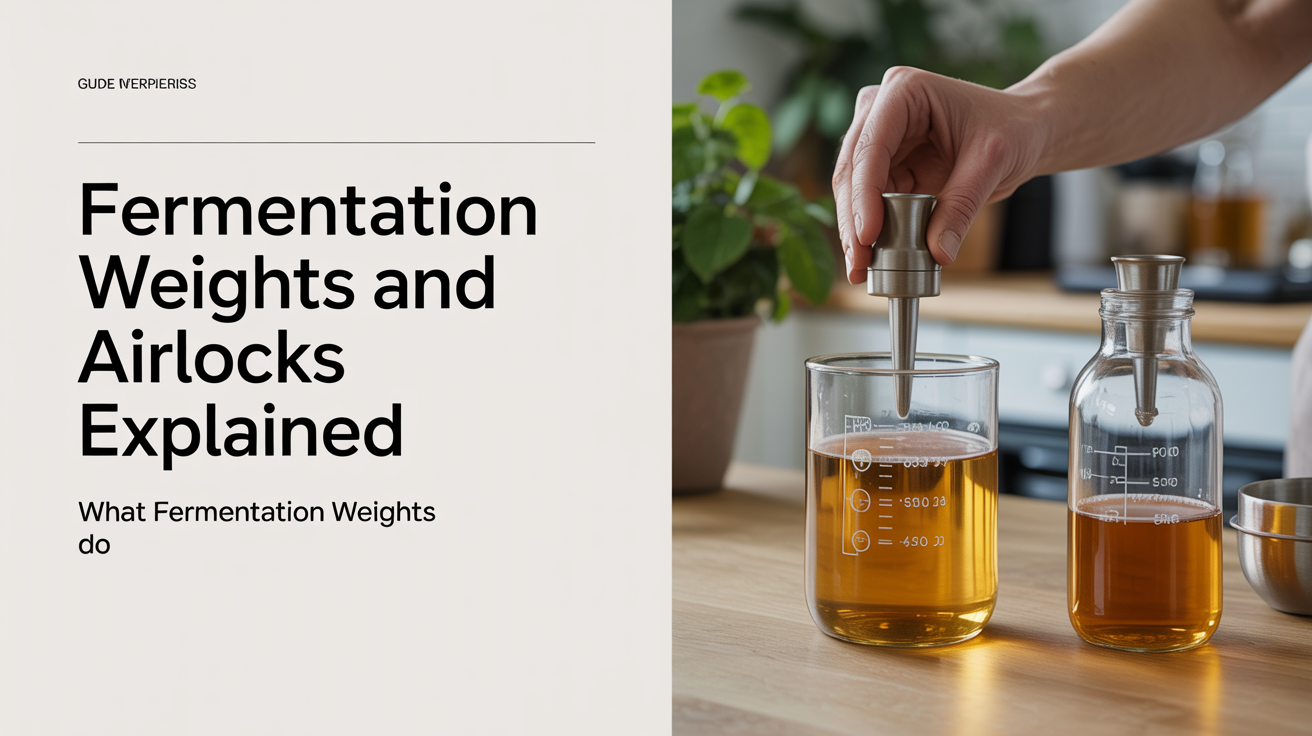
Vegetables float. That is the core problem. Shred cabbage, pack it into a jar, and within a few hours the top layer will drift above the brine line. Even a centimeter of exposed vegetable is enough for surface mold to start.
A weight holds everything down. That is its entire job. The brine acts as a barrier between your vegetables and oxygen, so as long as food stays submerged, fermentation proceeds cleanly.
The USDA-based National Center for Home Food Preservation guidance on fermenting containers is specific about how far under: cabbage and cucumbers should stay 1 to 2 inches under the brine surface throughout fermentation, not just barely submerged. That margin matters because brine levels drop slightly over time as vegetables absorb liquid and CO2 escapes, so starting with only a thin layer of brine over the top can leave you exposed within a few days.
Types of Fermentation Weights
Glass weights are the most common purchase for beginners. They are sized to fit wide-mouth mason jars snugly, they are easy to clean, and they do not introduce any off-flavors. A set of two runs about $10 to $15.
Ceramic weights work the same way and are slightly heavier, which can be useful for stubborn, buoyant vegetables like whole pickles. They cost a bit more but last indefinitely.
A small zip-lock bag filled with brine is a free alternative that works surprisingly well. Fill the bag with a 2% salt solution (rather than plain water, so a leak does not dilute your ferment), press it into the jar mouth, and seal. The bag conforms to the jar shape and pins everything below the waterline. This is essentially a home-scale version of the method USDA recommends for larger crocks: a large plastic bag filled with 3 quarts of water and 4.5 tablespoons of salt, roughly a 2% brine by weight, sealed and set on top of a plate to weigh it down.
A clean stone or small jar placed inside a larger jar can also work, especially in a crock or gallon jar. The stone should be food-safe (granite or river stone, not limestone or anything porous), and rinsing it in boiling water beforehand is good practice.
The material matters less than the result: food stays under brine.
What Fermentation Airlocks Do
As lactobacillus bacteria ferment your vegetables, they produce carbon dioxide. That CO2 has to go somewhere. In a sealed jar, pressure builds. In an open jar, oxygen can drift in.
An airlock threads the needle. It lets CO2 push out through a water seal while preventing outside air from coming back in. The result is a stable anaerobic environment without the pressure that builds in a sealed jar.
Types of Airlocks
Water-sealed airlocks (the kind used in home brewing) have a small chamber you fill with water. CO2 bubbles up through the water and out; the water blocks air from traveling back down. They require a drilled lid or a rubber grommet to seat properly in a mason jar lid.
Silicone valve lids are simpler. The valve flexes open under CO2 pressure and snaps shut when the gas stops. No water to refill, no chamber to clean. These fit standard wide-mouth mason jar lids and are the most beginner-friendly option.
Burping the lid is the no-tool approach. Once or twice a day, you loosen the lid to release built-up gas, then re-tighten. It takes about two seconds. This works perfectly well; the only downside is that you have to remember to do it and that brief open moment lets in a small amount of air.
Do You Actually Need Fermentation Weights and Airlocks?
For most home fermenters, both are optional. The fermentation will succeed without them if you keep an eye on things.
Weights are more important than airlocks. A vegetable floating above the brine is a real risk; a little CO2 pressure in a jar is not dangerous (mason jars vent before they burst). If you are choosing one tool to buy, choose a weight.
Airlocks become more useful for longer ferments (anything going past two weeks), for people who travel and cannot burp a jar daily, or for anyone who wants a set-and-forget setup.
See the fermentation equipment every beginner needs guide for a full starter kit list that covers which purchases actually matter.
Container Sizing: How Much Weight and Headspace You Need
Bigger batches need proportionally bigger weights and more headroom for brine and CO2. USDA guidance scales container size to roughly 1 gallon per 5 pounds of fresh vegetables, which gives a useful starting point for planning a batch.
| Container | Fresh vegetable capacity | Weight needed | Typical use |
|---|---|---|---|
| Quart mason jar | About 1-1.5 lbs | Single glass weight or small brine bag | Small test batches, single-vegetable ferments |
| Half-gallon jar | About 2.5 lbs | One glass/ceramic weight, or two | Standard household sauerkraut or pickle batch |
| 1-gallon crock or jar | About 5 lbs | Weighted plate or two sealed water-filled jars | Family-size batches, whole cucumbers |
| 5-gallon crock | About 25 lbs | Dinner plate weighted with 2-3 sealed quart jars | Bulk sauerkraut, holiday or preservation-season batches |
Quick-Reference Table
| Tool | What It Does | Needed or Optional | DIY Alternative |
|---|---|---|---|
| Glass fermentation weight | Holds food below brine | Recommended | Zip-lock bag filled with brine |
| Ceramic weight | Same as glass, heavier | Optional | Clean food-safe stone |
| Water-sealed airlock | Vents CO2, blocks oxygen | Optional | Burp the lid daily |
| Silicone valve lid | Vents CO2 automatically | Optional | Burp the lid daily |
| Brine bag | Doubles as weight and lid seal | Optional (very effective) | None needed |
How Weights and Airlocks Work Together
Using both is not overkill; it is just convenient. The weight handles submersion; the airlock handles gas. Together they let you pack a jar, walk away, and check it again in five days without doing anything in between.
If you are using a silicone valve lid, the jar is not truly airtight, so you do not need to worry about pressure. If you are using a standard mason jar lid (screwed just finger-tight, not cranked down), the lid will vent naturally before pressure becomes a problem.
What you do not want is a completely airtight seal without any venting. A jar sealed so tightly that CO2 cannot escape can build significant pressure over several days, especially in a warm kitchen. The solution is simple: either use an airlock, use a silicone valve lid, or leave the lid just loose enough to vent.
For more on choosing the right vessel for your ferment, read do you need a fermentation crock or will a jar work.
A Note on Salt
No weight or airlock substitutes for getting your salt ratio right. Too little salt and harmful bacteria can outcompete the lactobacillus even below the brine line. Too much salt slows or stalls fermentation. The brine is the environment your ferment lives in, and the weight just keeps your vegetables inside it. For specifics on which salt to use and how much, see what salt should you use for fermenting.
A surface film sometimes shows up even when your weight is doing its job, usually as a thin haze right where the weight meets the brine. That's a normal contact point for kahm yeast to start. NCHFP's troubleshooting guide for fermented pickles lists this as ordinary "scum on the brine surface" and recommends removing it as often as it reappears; it won't affect the ferment underneath as long as the vegetables themselves stay submerged.
Frequently Asked Questions
Can I use a regular rock as a fermentation weight?
Yes, with some caveats. The rock should be non-porous (granite and river-worn stones work well), free of limestone or calcium carbonate (which can react with acidic brine), and rinsed with boiling water before use. Enclose it in a clean zip-lock bag if you want to be extra cautious. Many fermenters have used clean rocks for years without any issues.
Do you need fermentation weights for sauerkraut?
You do not need a purpose-made weight, but you do need something to keep the cabbage submerged. The outer cabbage leaf folded over the shreds, pressed down with a small jar, or a brine-filled bag all accomplish the same thing. The goal is submersion, not the specific tool.
How much water goes in an airlock?
Fill the chamber to the fill line marked on the airlock, usually about halfway. Use plain water or a light salt solution. Check it every week or so; water can evaporate during a long ferment and leave the chamber dry, which defeats the purpose.
Is a silicone valve lid better than a water airlock?
For simplicity, yes. Silicone valve lids require no setup, no water refills, and no drilling. They are less fussy and easier to clean. Water airlocks give you visible confirmation that fermentation is active (you can watch bubbles), which some beginners find reassuring. Both work well.
What happens if I forget to burp my jar?
In most cases, nothing dramatic. A standard mason jar lid screwed on finger-tight will vent on its own before pressure becomes dangerous. You may hear a hiss when you open it, or notice the lid slightly bulging, but the jar will not explode. If your lid was cranked down very tight, open it carefully over a sink. Going forward, either leave the lid a little loose or switch to a silicone valve lid so you do not have to think about it.
I don't have a weight or a bag. Can I just use a clean dinner plate?
Yes, and it's the traditional method for crock fermentation. Use a plate slightly smaller than the container opening, so it can settle down inside and press on the vegetables, then weigh it down with something clean and heavy, like a couple of sealed, water-filled quart jars set on top. This is the same plate-and-jar method described in USDA's home fermentation guidance for larger batches, and it works just as well in a wide-mouth gallon jar as it does in a stoneware crock.
Do I need to sanitize my weight between batches?
Yes. Wash it in hot, soapy water and rinse well after every batch, the same way you'd wash any other food-contact surface. A weight that sat in a finished ferment can carry residual bacteria and yeast from that batch into the next one. For glass or ceramic weights this takes seconds; for a DIY zip-lock brine bag, just use a fresh bag each time rather than trying to reuse one.