Fermented Vegetables
Fermented Carrots, Beans, and Other Easy Vegetables
Learn to ferment carrots, green beans, radishes, and cauliflower with a simple 2-3% salt brine. Beginner steps, food safety tips, and timing included.
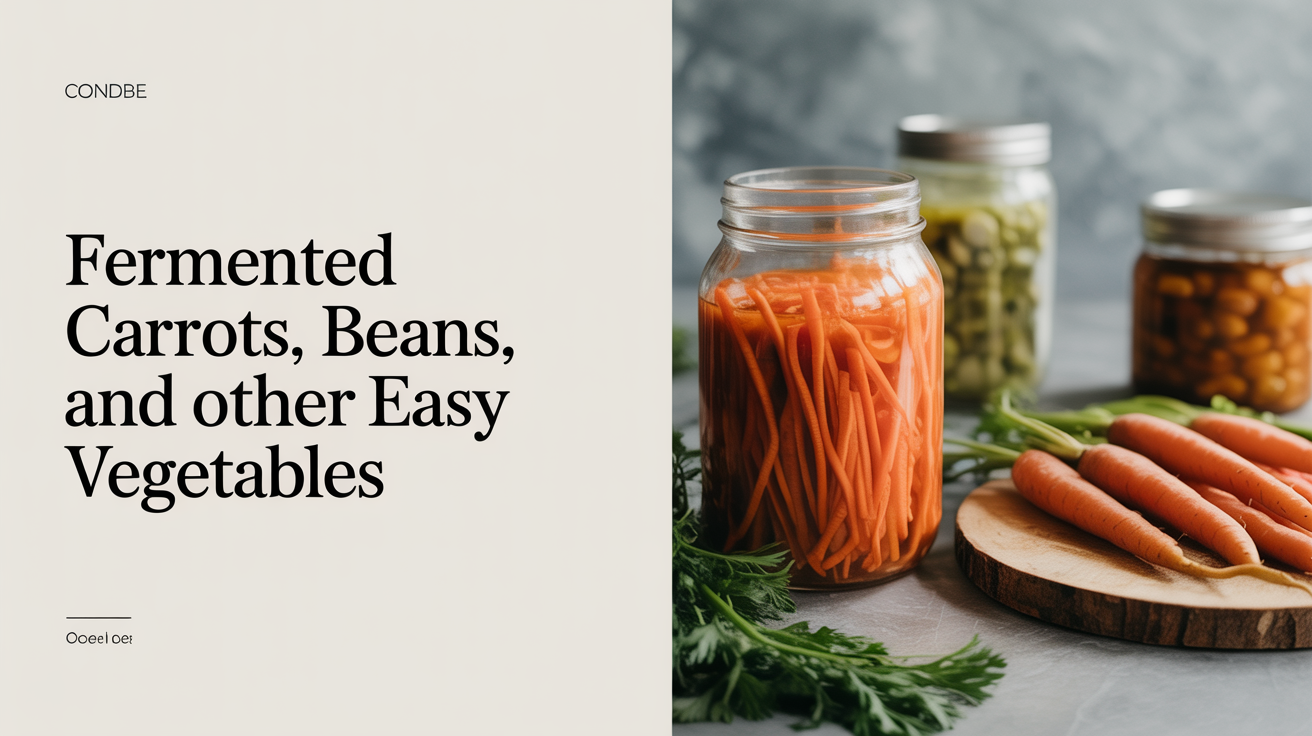
Fermented vegetables are one of the most forgiving places to start in home fermentation. You need only salt, water, a clean jar, and vegetables, and the microbes already on the produce do most of the work. Carrots, green beans, radishes, and cauliflower are all solid first projects: they hold their shape, stay crunchy through a short ferment, and give you a clear window into how lacto-fermentation actually works before you move on to anything more involved.
The method here is a straightforward salt-water brine ferment, sometimes called a lacto-ferment or wild brine. It is the same underlying process used for classic sauerkraut and fermented pickles, just applied to a wider range of vegetables. Once you understand the ratio and the rhythm of a brine ferment, you will be able to adapt it to almost anything crunchy in your produce drawer.
The Salt Brine: Getting the Ratio Right
Salt is not just for flavor in lacto-fermentation. It creates an environment where Lactobacillus bacteria thrive and competing pathogens cannot. Too little salt and you risk spoilage. Too much and fermentation stalls before the good bacteria can get going.
For most vegetables, a 2 to 2.5% brine by weight hits the right balance. Here is how to calculate it:
- Weigh your water in grams.
- Multiply by 0.02 for 2% or 0.025 for 2.5%.
- Weigh out that amount of non-iodized salt (kosher or pickling salt).
Example: 500 g water x 0.02 = 10 g salt for a 2% brine.
Avoid iodized table salt. The iodine is added to inhibit bacterial growth, which is exactly what you do not want here. Plain kosher salt or pickling salt both work well. Sea salt is fine as long as it does not contain anti-caking additives.
Mix your brine in a measuring cup or bowl until the salt is fully dissolved. You can use room-temperature water; you do not need to boil it. If your tap water is heavily chlorinated, let it sit uncovered for an hour or use filtered water, since chlorine can slow fermentation.
How to Ferment Carrots
Fermented carrots are a great starting batch. They stay crisp for weeks, take on a pleasant tang, and work well as a snack or garnish. The process for green beans, radishes, and cauliflower follows the same numbered steps with minor adjustments noted after.
What you need:
- 1 pound (450 g) carrots, peeled and cut into sticks or coins
- 2% to 2.5% salt brine (roughly 1.5 to 2 cups / 350 to 475 ml, enough to cover the carrots)
- A clean quart (1-liter) jar
- A weight to keep the carrots submerged (a small zip-lock bag filled with brine works well)
Steps:
- Wash your jar with hot soapy water and rinse well. You do not need to sterilize it; clean is enough.
- Cut the carrots into sticks about 3 to 4 inches (7 to 10 cm) long so they stand upright in the jar, or slice into coins if you prefer.
- Pack the carrots tightly into the jar. Tighter packing helps keep them submerged later.
- Mix your salt brine and pour it over the carrots, leaving about 1 inch (2.5 cm) of headspace at the top.
- Place a weight on top of the carrots so they stay fully below the brine. Any piece of carrot that pokes above the liquid is exposed to air and at risk of surface mold.
- Cover the jar loosely, either with a cloth secured by a rubber band, a loose lid, or a purpose-made fermentation airlock lid. You want gas to escape but not a lot of outside air to come in.
- Set the jar at room temperature, out of direct sunlight.
Timing: At 65 to 75 F (18 to 24 C), carrots are ready in 3 to 7 days. Cooler kitchens (around 60 F / 15 C) push this to 10 to 14 days and produce a milder tang. Taste them starting on day 3 and decide when you like the flavor. Once they taste right to you, cap the jar and move it to the refrigerator.
Adapting the Method for Green Beans, Radishes, and Cauliflower
The salt brine and basic steps above apply to all of these, with a few notes:
Fermented green beans (sometimes called dilly beans when made with garlic and dill): Trim the ends and pack them upright just like carrot sticks. Add a garlic clove and a few dill fronds if you like. Timing is similar to carrots, 4 to 7 days at room temperature.
Radishes: Slice into coins or matchsticks. They ferment quickly, often in 2 to 4 days, and turn a deep pink-purple color that bleeds into the brine. This is normal and not a safety concern. The flavor softens from sharp and peppery to mellow and tangy.
Cauliflower: Break into small florets and pack loosely (they are not as dense as root vegetables). Timing is 4 to 7 days. Cauliflower absorbs aromatics well, so try adding a teaspoon of turmeric, a few black peppercorns, or a pinch of red pepper flakes to the brine.
For more variety in your fermented vegetable lineup, kimchi uses a similar lacto-ferment process but with a paste instead of a poured brine, and the flavor profile is completely different.
Keeping Ferments Safe: What to Watch For
Lacto-fermentation is a well-established preservation method, but a few things can go wrong, and you need to know how to read them.
Keep vegetables submerged. This is the single most important rule. Below the brine, the environment is anaerobic (low in oxygen), which is where Lactobacillus bacteria thrive. Above the brine, you are in mold territory. Check your jars once or twice a day for the first few days and press anything floating back down.
Bubbles are a good sign. You should see small bubbles in the brine within 24 to 48 hours, especially at room temperature. This is the bacteria producing carbon dioxide and it means fermentation is active.
Kahm yeast vs. mold. A white, thin, flat film on the surface of your brine is usually kahm yeast, not mold. Kahm is harmless but can add an off-flavor if left to build up. Skim it off with a clean spoon and keep the vegetables submerged. Mold looks fuzzy, three-dimensional, and may be white, blue, green, or black. If you see fuzzy mold on your vegetables (not just on the surface of the brine), discard the batch. It is not worth the risk. When in doubt, throw it out.
Smell as a guide. A healthy ferment smells sour and tangy, a bit like vinegar or pickles. Off smells, including truly rotten, putrid, or chemical odors, are a sign something went wrong. Trust your nose; a good ferment smells like something you want to eat.
Temperature matters. Below 60 F (15 C), fermentation slows considerably and may stall. Above 80 F (27 C), fermentation speeds up but can produce overly soft vegetables and more kahm yeast. The 65 to 75 F (18 to 24 C) range gives you the best control.
Frequently Asked Questions
How long do fermented vegetables last in the refrigerator?
Most fermented vegetables keep for 2 to 3 months in the refrigerator, sometimes longer. The cold temperature slows (but does not stop) fermentation, so they will continue to get slightly tangier over time. Keep them submerged in brine in a sealed jar.
Do I need to use a special fermentation jar?
No. A standard wide-mouth mason jar works fine. Fermentation crocks and airlock lids are helpful but not required for short ferments like these. The main thing is to keep the vegetables submerged and allow gas to escape. A loosely placed lid or a cloth cover does the job.
Can I reuse the brine for another batch?
Yes, with some caveats. The brine from a finished batch is full of live Lactobacillus and can jumpstart your next ferment. Add it to fresh brine (not instead of, but alongside) in your next jar. Do not reuse brine that smelled off or had visible mold.
Why did my carrots turn soft?
Soft carrots usually mean the ferment got too warm, ran too long, or the brine was too weak. Use fresh, firm carrots and aim for cooler room temperatures. Moving the jar to the refrigerator earlier in the ferment keeps more crunch.
Is it safe to ferment vegetables without a starter culture?
Yes. The bacteria that drive lacto-fermentation are naturally present on the surface of raw vegetables and in the air. You do not need to add a starter. Salt and an anaerobic environment select for the right bacteria. This is how people have preserved vegetables for centuries, well before packaged cultures existed.